TVS LP 46 Dlite BT Barcode Printer for Indian Business Labels
Why This Printer Is Getting Attention in India
For many Indian businesses, barcode printing is no longer a back-office task. It now sits at the centre of dispatch accuracy, inventory control, retail operations, and order fulfilment. When labels print clearly and on time, teams move faster, errors drop, and customers get a better experience. That is why many buyers now look beyond basic printers and focus on models that can handle daily commercial use with stable connectivity and dependable output.
The TVS LP 46 Dlite BT Barcode Printer stands out because it is built for practical business use. The referenced India product page presents it as a barcode and label printer designed for shipping, warehousing, logistics, and manufacturing. It highlights high-speed printing up to 152 mm per second, support for USB, Serial, Ethernet, and Bluetooth, and compatibility with common barcode and label tasks that matter to business users in India.
Businesses searching for a printer today usually want three things. They want smooth integration with existing systems, low disruption on the shop floor or in the warehouse, and reliable output over repeated use. The LP 46 Dlite answers that buying intent well because it combines business-ready connectivity with ribbon support, memory, and label handling features that make routine operations easier. That makes it relevant for resellers, retailers, distributors, logistics operators, and manufacturing units across India.
What Makes the LP 46 Dlite a Practical Choice
The first reason this model appeals to commercial buyers is speed. The page lists a maximum print speed of 152 mm/s, or 6 inches per second. In real working environments, that matters because faster printing supports busier dispatch desks, barcode generation for stock movement, and label creation during peak order periods. A printer that keeps pace with operations can reduce avoidable bottlenecks.
The second reason is connectivity. The TVS LP 46 Dlite Label Printer USB Serial Ethernet setup gives businesses more flexibility than a single-interface model. Many Indian companies still run mixed infrastructure. Some use older ERP-linked systems, some rely on USB-based desktops, and some need network access across workstations. With USB, Serial, Ethernet, and Bluetooth support listed on the product page, this printer fits into varied setups without forcing a major system change.
Another strong point is operational continuity. The printer is shown with 64MB Flash and 32MB SDRAM, which helps with larger print queues and smoother processing. It also features a 300m ribbon capacity, reducing the need for frequent ribbon changes, and the page states a print head life of 50 km for durability during long-term use. These details are useful for buyers who compare total day-to-day convenience, not just the initial price.
Where Indian Businesses Can Use It
Retail and Distribution Counters
In Indian retail and distribution environments, quick barcode and label printing supports smoother receiving, labelling, and stock transfers. A printer like the LP 46 Dlite printer BT helps teams create product labels, shelf labels, and inventory tags without slowing daily activity. When label quality stays consistent, scanning accuracy improves and manual rework drops. That saves time for both staff and customers.
Warehousing and Logistics Operations
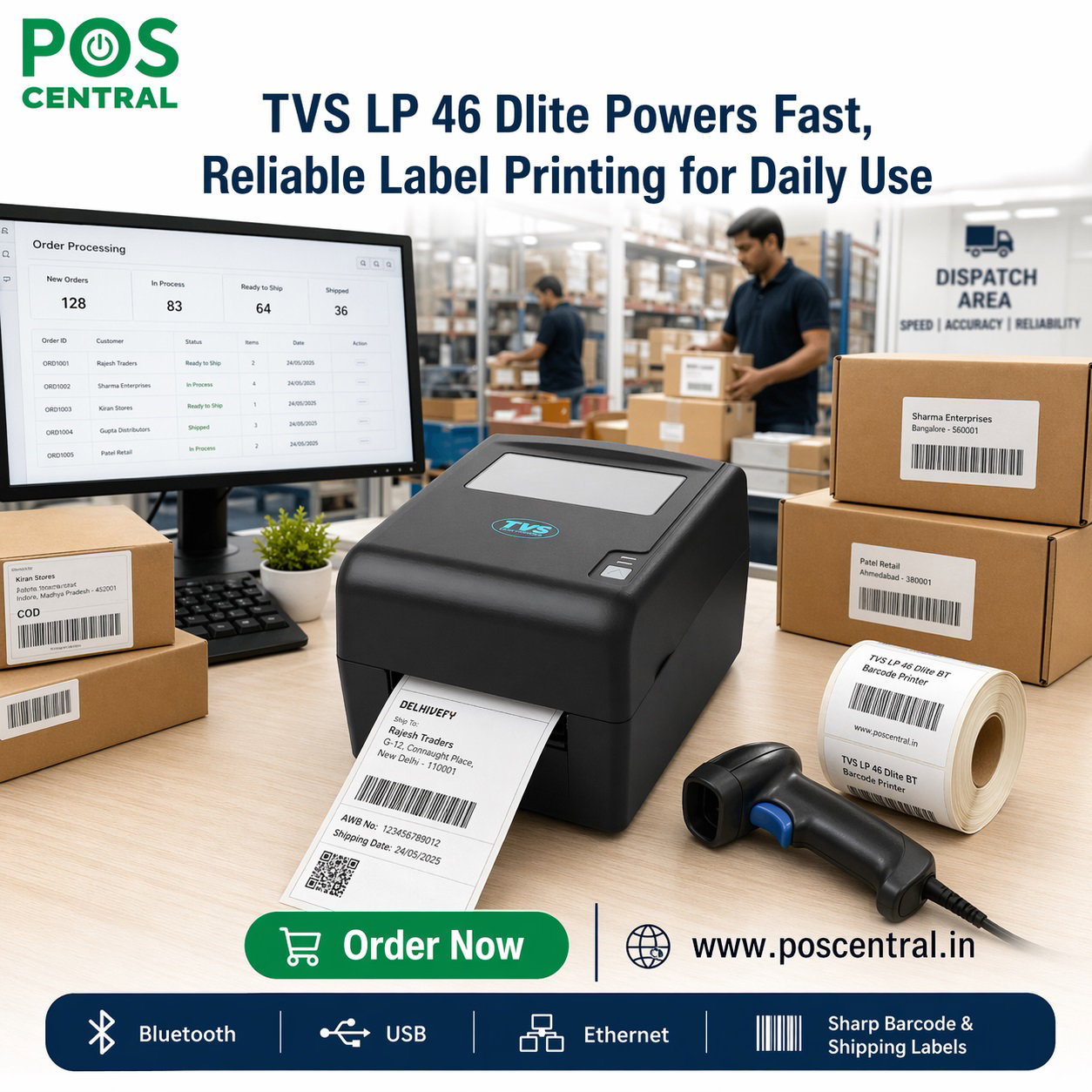
Warehouses and logistics teams often need dependable printing for carton labels, shipping labels, and tracking labels. The product page specifically positions the printer for shipping, warehousing, and logistics, which makes it directly relevant for Indian fulfilment centres and dispatch operations. Businesses handling frequent order movement often value speed, barcode support, and easy network connection more than cosmetic features.
Manufacturing and Asset Tracking
Manufacturing units need labels for bins, finished goods, components, and asset identification. The product page also names manufacturing among the intended industries and notes support for barcode labels, shipping labels, and asset tags. That makes the TVS LP 46 Dlite Thermal Transfer Printer a good fit for plants that want cleaner product identification and better tracking inside production and storage environments.
Why Connectivity Matters More Than Ever
Many label printer buyers focus first on print speed or price. Yet connectivity often decides how useful the printer really becomes after installation. A model can look affordable at purchase time, but if it struggles to fit into your workflow, it creates delays and extra support work. That is why the interface mix on this model is a major strength for Indian business users.
USB for Simple Desktop Setups
USB remains the easiest option for many single-user or counter-based environments. Smaller businesses, branch counters, and front-desk operations often want a label printer that can be installed quickly on a workstation with minimal complexity. For such setups, USB keeps things simple while still supporting everyday label output.
Ethernet for Shared Business Use
Ethernet becomes important when multiple staff members or workstations need access. This is common in warehouses, back offices, and dispatch units. Network-connected printing supports a more structured workflow and reduces dependence on one system. For growing businesses, that flexibility can matter more than saving a small amount upfront.
Bluetooth for Flexible Placement
Bluetooth adds practical convenience where cable placement is less ideal or where users want cleaner desk layouts. While not every business uses wireless printing every day, having that option increases adaptability. For teams that shift equipment locations or work in tighter spaces, this added flexibility can be useful.
Print Performance That Supports Daily Work
A business printer should not only print fast. It should also handle routine pressure without constant interruption. The TVS LP 46 Dlite is built around that idea. The 300m ribbon capacity helps reduce stoppages, while the memory configuration supports smoother handling of print jobs. This is valuable for operations that print in batches or at regular intervals through the day.
This printer supports multiple paper types and sizes, including continuous, marking, label, and perforated papers. It has options like tear off, rewind, and peel off. These features matter because businesses in India often do not follow one uniform labelling format. They may need shipping labels in one workflow, barcode labels in another, and inventory or product labels elsewhere. Flexible media handling makes the printer more useful across departments.
Support for Common Barcode Formats
This barcode printer has support for 1D barcode formats such as Code39, Code128, and EAN-13, along with 2D options including QR Code and PDF417. This is important for businesses that serve different supply chains, retailer requirements, or internal tracking needs. A printer that supports common barcode standards is easier to deploy in real business conditions.
How to Judge If This Printer Fits Your Business
Before buying, it helps to assess your actual label workload. A growing business should think about how many labels it prints in a day, who will use the printer, what systems it must connect to, and whether labels are mostly shipping-focused, stock-related, or product-based. These practical questions lead to better buying decisions than comparing only headline pricing.
Choose Based on Workload, Not Just Cost
If your business prints labels regularly and cannot afford delays during dispatch or stock processing, a better-built model usually delivers stronger long-term value. Ribbon capacity, connectivity options, and durable operation often become more important over time than the initial discount on a basic unit.
Think About Future Expansion
Many Indian businesses begin with one workstation and later expand to shared operations. Choosing a printer with Ethernet and Bluetooth from the start can reduce the need for early replacement. It also gives more room to adapt as your processes grow.
For buyers comparing options online, the referenced product page from POS Central India presents the model as a high-speed solution for label-intensive environments and lists clear use cases that align with Indian business needs. For businesses that want a balanced combination of speed, connectivity, and workflow flexibility, it deserves serious attention.
Final Thoughts
The TVS LP 46 Dlite BT Barcode Printer is well suited to Indian businesses that need dependable label output for commercial use. It is not positioned as a casual, light-duty device. Instead, it is presented for shipping, logistics, warehousing, and manufacturing where label printing supports operational flow every day.
Its mix of USB, Serial, Ethernet, and Bluetooth makes it easier to place into varied business environments. Its 6 IPS print speed, ribbon capacity, memory, media support, and barcode compatibility strengthen its value for B2B buyers who care about workflow efficiency. For companies looking for a capable TVS LP 46 Dlite Thermal Transfer Printer that matches real Indian operating needs, this model offers a practical and business-focused choice. Buyers exploring reliable barcode printing options can review it through POS Central India as part of a more informed purchase decision.
FAQs
1. What is the TVS LP 46 Dlite BT Barcode Printer mainly used for?
It is mainly used for barcode labels, shipping labels, asset tags, and other business labels. The product page highlights use in shipping, warehousing, logistics, and manufacturing.
2. Does the TVS LP 46 Dlite support multiple connectivity options?
Yes. The page lists USB, Serial, Ethernet, and Bluetooth connectivity, making it suitable for different business setups.
3. How fast can the LP 46 Dlite print?
The listed maximum print speed is 152 mm/s, which is equal to 6 inches per second.
4. Is this printer suitable for warehouse and logistics work?
Yes. The product page specifically presents it for warehousing, logistics, and shipping tasks, where fast and reliable label printing is important.
5. What barcode formats does it support?
It supports 1D formats such as Code39, Code128, and EAN-13, along with 2D formats such as QR Code and PDF417.
6. Why does ribbon capacity matter in a business label printer?
A larger ribbon capacity helps reduce stoppages for ribbon replacement. On this model, the page lists a 300m ribbon capacity, which can help improve continuity during regular printing work.
